
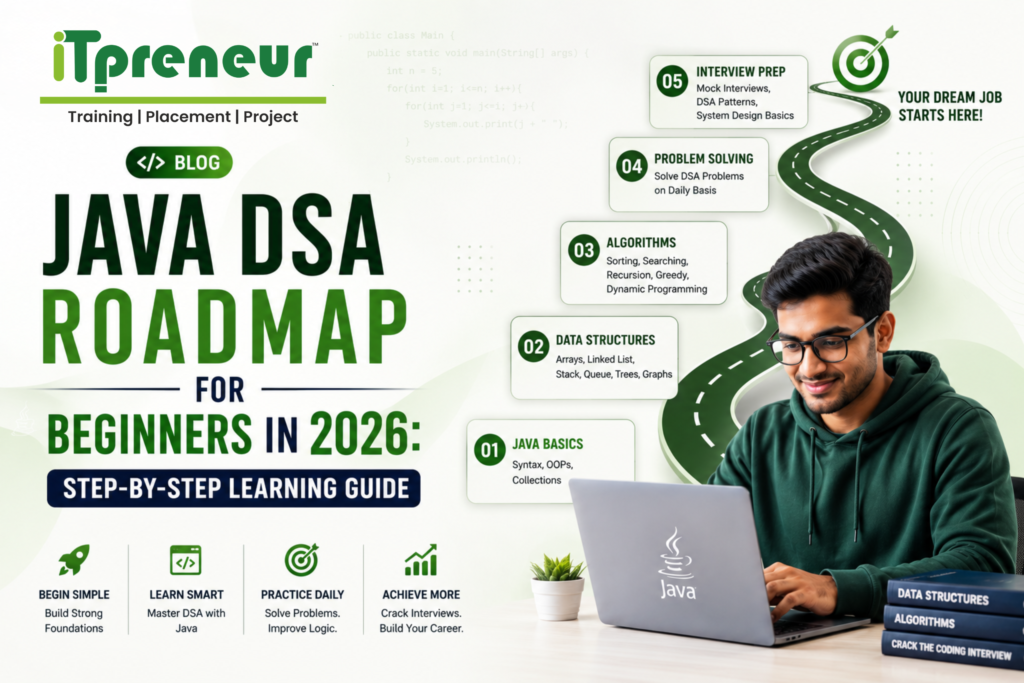
Java DSA Roadmap for Beginners in 2026: Step-by-Step Learning Guide
Java DSA Roadmap is one of the most effective learning paths for aspiring software developers preparing for coding interviews, placements, and software engineering careers in 2026. Moreover, Data Structures and Algorithms help developers write efficient code and solve complex problems. In addition, strong DSA skills are highly valued by recruiters at technology companies. Therefore, following a structured Java DSA Roadmap can significantly improve your problem-solving abilities and career opportunities.
Why Follow a Java DSA Roadmap in 2026?
Java remains one of the most popular programming languages for software development and technical interviews. Learning DSA in Java helps improve problem-solving skills and prepares you for coding assessments and placement opportunities.
Benefits of Learning DSA in Java
Java provides strong object-oriented programming support. Moreover, it is widely used in enterprise applications. In addition, many companies prefer Java during coding interviews because of its reliability and performance.
Java DSA Roadmap Step 1: Master Java Fundamentals
Before starting DSA, build a solid foundation in Java programming.
Core Java Topics to Learn
- Variables and Data Types
- Operators
- Conditional Statements
- Loops
- Methods and Functions
- Arrays
- Strings
- Exception Handling
- Object-Oriented Programming (OOP)
Practice Programs for Beginners
- Number-based programs
- Pattern printing
- String manipulation
- Array problems
Step 2: Understand Time and Space Complexity
Understanding algorithm efficiency is a fundamental part of DSA.
What is Big O Notation?
Big O notation measures how efficiently an algorithm performs as input size increases.
Common Time Complexities
| Complexity | Big O |
|---|---|
|
Constant |
O(1) |
|
Logarithmic |
O(log n) |
|
Linear |
O(n) |
|
Linearithmic |
O(n log n) |
|
Quadratic |
O(n²) |
Java DSA Roadmap Step 3: Learn Basic Data Structures
Arrays and Strings
Learn operations such as:
- Traversal
- Insertion
- Deletion
- Searching
- String Reversal
- Palindrome Checking
- Anagram Problems
Linked Lists
- Singly Linked List
- Doubly Linked List
- Circular Linked List
Step 4: Understand Stacks and Queues
Stack Data Structure
Key Operations:
- Push
- Pop
- Peek
Applications:
- Expression Evaluation
- Undo Operations
Queue Data Structure
Types:
- Simple Queue
- Circular Queue
- Priority Queue
Applications:
- Task Scheduling
- CPU Management
Step 5: Learn Recursion
Core Concepts of Recursion
- Base Cases
- Recursive Calls
- Backtracking
Common Recursion Problems
- Factorial
- Fibonacci Series
- Tower of Hanoi
Step 6: Learn Tree Data Structures
Binary Trees
Binary Search Trees (BST)
Tree Traversal Techniques
- Inorder
- Preorder
- Postorder
- Level Order
Step 7: Learn Hashing
HashMap
HashSet
Collision Handling
Applications:
- Fast Data Retrieval
- Duplicate Detection
Java DSA Roadmap Step 8: Learn Sorting Algorithms
Basic Sorting Algorithms
- Bubble Sort
- Selection Sort
- Insertion Sort
Advanced Sorting Algorithms
- Merge Sort
- Quick Sort
Focus on:
- Time Complexity
- Space Complexity
- Real-world Applications
Step 9: Learn Searching Algorithms
Linear Search
Binary Search
When to Use Each Searching Algorithm
Compared to Data Science, Web Development generally requires less mathematical knowledge.
Step 10: Learn Graphs
Graph Fundamentals
- Vertices
- Edges
Breadth First Search (BFS)
Depth First Search (DFS)
Applications:
- Social Networks
- Navigation Systems
- Routing Algorithms
Developers must keep up with new frameworks and programming trends.
Heap
Trie
Segment Tree
Disjoint Set Union (DSU)
Step 12: Master Dynamic Programming
Dynamic Programming is one of the most important topics for technical interviews.
Memoization
Tabulation
Popular Dynamic Programming Problems
- Knapsack Problem
- Longest Common Subsequence
- Fibonacci DP
Best Platforms for Practice
- LeetCode
- HackerRank
- CodeChef
- GeeksforGeeks
Daily Practice Goals
Beginner: 2–3 Problems
Intermediate: 4–5 Problems
Advanced: 6+ Problems
6-Month Java DSA Roadmap for Beginners
First Month
- Java Basics
- OOP Concepts
- Arrays
- Strings
Second Month
- Linked Lists
- Stacks
- Queues
Third Month
- Recursion
- Searching
- Sorting
Fourth Month
- Trees
- BST
- Hashing
Fifth Month
- Graphs
- Heaps
- Greedy Algorithms
Sixth Month
- Dynamic Programming
- Mock Interviews
- Placement Preparation
Common Mistakes Beginners Should Avoid
Learning Theory Without Practice
Ignoring Time Complexity
Jumping Directly to Dynamic Programming
Memorizing Solutions
Inconsistent Practice
Learning Java DSA requires consistency, practice, and the right guidance. If you’re looking for professional support to build a strong programming foundation and prepare for coding interviews, Get Expert Career Guidance to understand the best learning path based on your career goals.
Final Thoughts on This Java DSA Roadmap
A structured Java DSA roadmap can help beginners build strong problem-solving skills and prepare for coding interviews, placements, and software development careers. Focus on understanding concepts, implementing them in Java, and solving problems consistently. With regular practice and a clear learning path, you can become interview-ready and significantly improve your chances of success in 2026.